RIVER runs through Rantoul, C-U
~~~~~
Champaign-Urbana is nothing if not a product of the ebb-and-flow inherent to a college town. All of us who’ve known the C-U for any length of time have realized that its transitional nature is simply part of the fabric. It is therefore always intriguing and exciting when new neighbors come to town and bring with them their myriad talents, their exuberant dreams, their honed expertise, and their genuine enthusiasm to contribute to our world and continue what they’ve ventured so far. In these respects, Vijay M. Rajan shares a common thread; what is uncommon, though, is that he is someone established in our particular milieu, which has been finally showing some staying power in Champaign County after more than three decades of trial and error by our creative community who utilize media tools to dramatize and engage.
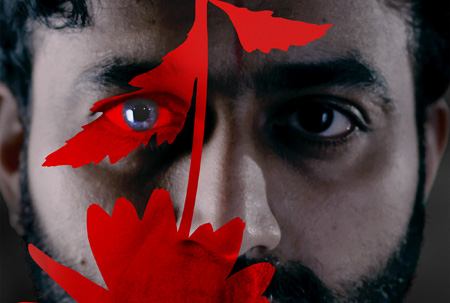
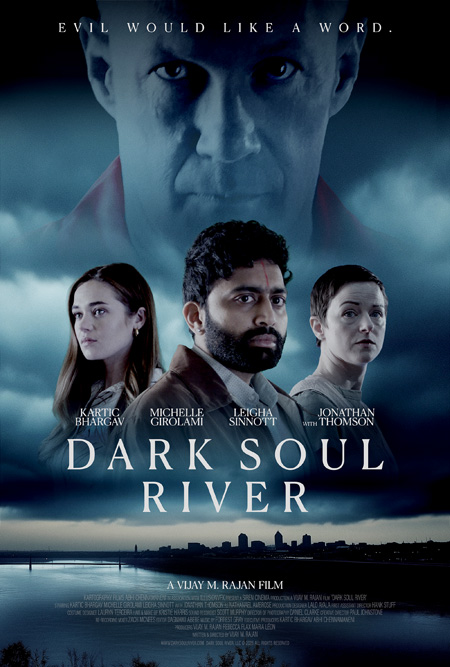
Since his arrival five years ago, Rajan has put together a feature thriller called DARK SOUL RIVER, of which a public audience will get its first look starting at 7:30 p.m. this coming Saturday, September 19, at the Virginia Theatre in downtown Champaign. Filmed locally at the campus of Flyover Film Studios in Rantoul as well as key locations in that city and Urbana, the movie is an unusual spin on the “serial killer and seeming prey” conceit where a Hindu man named Saarathi (producer Kartic Bhargav) comes to America to seek answers in the death of his sister, Urvi (Archana Raja), at the hands of an incarcerated felon named Nathanael Ambrose (Jonathan Thomson) and known in the public eye as the Kaw Valley Killer. Saarathi agrees to meet with Ambrose in a cold interrogation room, for the fiend will only open up to this particular visitor as to where his victims lie. You can watch the tense teaser on YouTube.
C-U Blogfidential enjoyed the opportunity to speak with Rajan about his debut feature in advance of the premiere showing. Having taken numerous roles in various avenues of multimedia and performance prior to his arrival in our fair Twin Cities with his wife, Rajan seems poised to do the same here in east central Illinois and is willing to call in the creative reinforcements from all over, as well as collaborate with the wealth of talents in town, to explore and realize what’s on his fertile mind. DARK SOUL RIVER is emblematic of what he promises are many arts endeavors to come.
~ Jason Pankoke
~~~~~
~~~~~
C-U Blogfidential: Vijay, thank you so much for talking with us about your latest film production, DARK SOUL RIVER, which will enjoy a “workprint premiere” at the historic Virginia Theatre in downtown Champaign on Saturday, September 19.
Vijay M. Rajan: Hi, Jason, Pleasure to speak with you.
CUBlog: Like all independent projects of scope, it feels like a labor of love for you and your team based on what you’ve shared online during the production process with high hopes for it once you begin to search for both festival play and commercial distribution. Overall, what is a “workprint premiere,” and what should the general public expect, both of the film itself and the Virginia event?
VMR: The film is completely done, and we’re so excited to share it with our first audiences here in Champaign-Urbana. A workprint is simply the first DCP, or digital cinema package, export of the final film, with DCP being the format that allows us to see DARK SOUL RIVER in a theater. So, while I’ve seen the film a hundred times by now, even I’ve never seen it on the big screen like this! While the film is complete, based on how it looks and sounds, we might make minor adjustments to the mix and color afterwards. And yes, the movie was very much a labor of love for myself and the team. We are extraordinarily proud of it.
What audiences can expect is a really cool psychological thriller in the vein of THE SILENCE OF THE LAMBS but with a multicultural twist. As I’ve been telling everyone, it’s not jump-scare horror; it’s much more of a human journey dealing with very relatable issues like family and grief while never forsaking the thriller genre and pulse-pounding elements. We have an unforgettable serial killer, surprises you won’t see coming, an absolute banger of a soundtrack, and actors that deliver.
At the Virginia event, we will have a red carpet, the screening itself, and a moderated Q&A [led by local actress, talk radio talent, and DARK SOUL RIVER voiceover artist Kimberly Schofield] with myself, the cinematographer, and our four leads, all of whom are flying in from New York and California to celebrate with us. It’s going to be a memorable, very special night.
CUBlog: DARK SOUL RIVER is your first production to see fruition as a resident of Champaign County after your previous film and theater work in prior homes like the Bay Area in California. It feels like you pulled together a crew of long-time collaborators, professional acting talent, and Illinois-based craftspeople and film industry folks to make the project a reality. How did the experience go overall, and what virtues of the east central Illinois area were you able to effectively put towards the show?
VMR: I am so grateful I shot this movie here in central Illinois. I was constantly impressed by the professionalism and quality of the talent and resources available here, and how well they worked with the people I flew in from the rest of the country. And consequently, I was able to make a movie that looks studio quality at a much more affordable price. The truth is, I’ve worked in Los Angeles, the Bay Area, New Mexico, New York – a lot of major production hubs – and central Illinois matches them all in terms of its potentials within the industry.
I think the biggest virtue of shooting here is the generosity and enthusiasm of the people. There is a sincere entrepreneurship here – one based on dedication, craft, and practical realities – and I’m really hoping this will be only the first of many movies I will shoot in central Illinois.
~~~~~
~~~~~
CUBlog: All movies take time and hard work to develop and execute. How long has the process been for DARK SOUL RIVER from the time you came up with the story concept to the end of post-production?
VMR: I had the table read for the completed script in September of 2024, so it’s been just about two years from that point to the screening.
CUBlog: Is the version of DARK SOUL RIVER we will see at the Virginia in the ballpark of the film that you originally wanted to make?
VMR: I have to tell you, for the most part, this is absolutely the film I wanted to make, only … more. I have an amazing cinematographer, a local named Daniel Clarke, and the movie looks stunning, beyond what I could’ve hoped. I have a virtuoso L.A. music composer, Forrest Gray, who I think has absolutely outdone himself with seventy-five minutes’ worth of incredible music. I have a VFX [visual effects] company from India [named IllusionVFX] that has delivered some incredibly cool effects shots that should have been unthinkable at our budget. And that’s just in post.
In every category, this remarkable cast and crew have surpassed my expectations, not only delivering on what I had imagined, but delivering in such a way that the whole is leagues above the sum of the parts. I truly cannot believe my luck when it comes to the alchemy of the people that got involved on this project. When the cast and crew are clicking, what a director gets to do on set is dance.
CUBlog: We imagine the translation from the page to the screen still involved a series of tweaks as you went along, even if they were ultimately minor and in ways that only you will pick up on when the finished piece is screened for audiences.
VMR: It’s not major changes from the original script that I am must proud of, but the immediate creative ideas that we were able to implement so well and so quickly to lock down the major thematic ideas of the story.
CUBlog: Like many film productions that have come to the area in the last three or four years, a portion of the filmmaking schedule for DARK SOUL RIVER was headquartered at the Flyover Film Studios in Rantoul or what it was previously, the defunct Octave Chanute Air Force Base. What were the primary benefits for you in using their services?
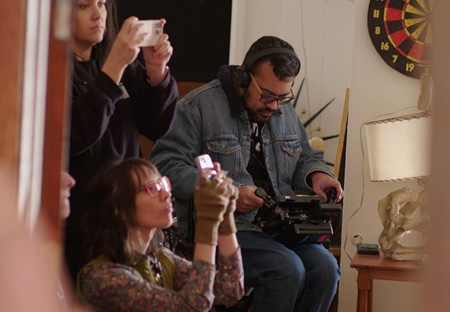
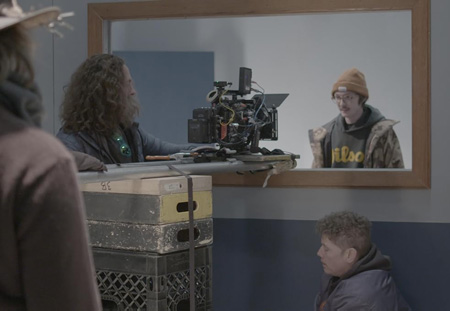
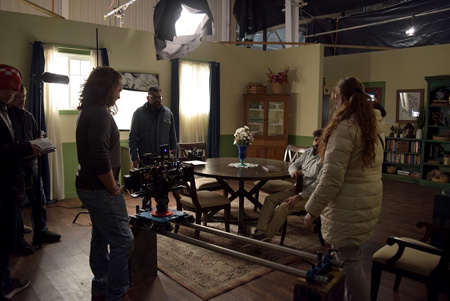
VMR: I couldn’t have done this movie without Flyover. From the start, Rob Stern and Sarah Sharp were instrumental in helping me put together this crew, find the necessary film resources from insurance to locations, and introducing me to the people that made it all possible. And yes, we did use their soundstages. Our most crucial location, the interrogation room, was built at Flyover, and so were three other major sets.
I love what Rob and Sarah and everyone else at Flyover – too many people to list – are doing; as filmmakers themselves, they understand the needs of production and are working to make it as easy as possible to produce there.
CUBlog: Where else in the Champaign-Urbana-Rantoul area did you film on location?
VMR: In addition to Flyover in Rantoul, we also shot at the iconic Royer House in Urbana, at Kickapoo State Park, and at [the facilities of] the Rantoul Recreation Department.
~~~~~
~~~~~
CUBlog: Please introduce us to your main out-of-town cast and crew who also helped to create DARK SOUL RIVER. Have you worked with some or all of these folks before?
VMR: My four leads were all discovered through nationwide auditions that we did for the film. All of them have appeared in studio and network movies and shows. They’re solidly working actors with strong resumes.
Only one I had met before, Kartic Bhargav. I have known Kartic for many years, as a Bay Area film and theater actor. But, believe it or not, I hadn’t really worked with him in a professional capacity until DARK SOUL RIVER. He brought such a humanity and pathos to the role of Saarathi.
From the first time I saw Jonathan Thomson’s audition as the Kaw Valley Killer, I was mesmerized by his frightening charisma. Michelle Girolami [as Ruth] has a soulfulness that really gives a warm quality to the film. And, Leigha Sinnott as the FBI agent just drives the pace of the film. I think the acting will blow people away.
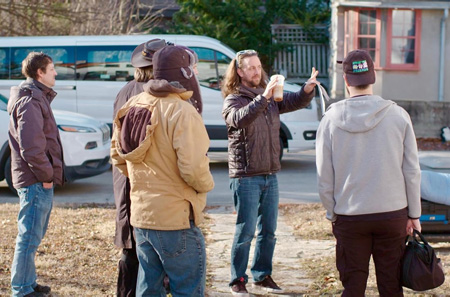
In terms of crew, we flew in my costume designer, Lauryn Terceira, from Los Angeles, where she has worked on projects like THE PITT, SHAMELESS, and LITTLE FIRES EVERYWHERE. My production designer, Illinois local Lalo Ayala, really brought to visual life the things I was imagining. My first assistant director Hank Stuff, sound recordist Scott Murphy, co-producer Alison Lecouris, and hair and makeup artist Kristie Harris are also Illinois locals. This was a family project, not in the sense that I previously knew everyone, but more in the sense that we quickly became family while working on it.
CUBlog: Other than the goals of telling a thrilling and compelling story that will stick with an audience after the end credits roll, you have made mention of or hinted at elements and themes in DARK SOUL RIVER that seem to come from a more personal place. How did your own background and life experience inform your approach to developing and making this movie?
VMR: It’s not so much personal as it is cultural. A son of an academic linguist, I’ve lived in India, Canada, Singapore, and the United States, and cultural differences in philosophy, spirituality, and religion fascinate me. There are certain themes that transcend cultural borders while the ways in which they are experienced could not be more varied. Grief is human but how we grieve can be intensely cultural.
So, one of the ways in which I began brainstorming this project was diving into the different ways two people from opposite halves of the globe – a serial killer and a victim’s brother – might view fundamental human concepts: grief, the soul, the body, family, language, choice, the natural world, vengeance, love, and evil itself. To give one basic example: some people bury the bodies of their loved ones so they can visit them in the graveyard; Hindus, and many other people around the world including here, cremate the bodies until there is nothing left but ash, which too is dispersed and not kept in an urn in memorial.
My central conceit – a traditional Hindu trying to get a serial killer to finally reveal where the bodies are buried – is automatically enriched by this diversity, allowing opportunities for narrative progression that make perfect sense but are new to the genre. I wish I could say more, but I don’t want to give any spoilers. Come to the film and the moderated Q&A afterward, and I’ll get into this in more depth.
But I will say, as an Indian immigrant, multiculturalism – not just in terms of representation of skin color but also of philosophy – is deeply personal to me. Additionally, done as genre, it remains accessible to the mainstream American audience whom I wish to be in conversation with.
~~~~~
~~~~~
CUBlog: What kinds of films do you like to watch personally, or are there certain films or particular talent you look to in terms of studying or interpreting the craft of filmmaking? How does this mode of storytelling inspire you?
VMR: I’m an oddball in the sense that I don’t have a favorite genre for study or pleasure, but I would say the movies that most influenced me are ones in which clever, resourceful characters win against insurmountable, very real, and frightening obstacles – light through darkness.
No surprise, then, that my favorite movie of all time is THE SHAWSHANK REDEMPTION; of course, if you want to learn about cinematography or filmmaking craft, you can’t go wrong with [SHAWSHANK director of photography and Oscar winner] Roger Deakins. A BEAUTIFUL MIND, CONTACT, MISERY, HOTEL RWANDA, WARRIOR, MISSISSIPPI BURNING, THIRTEEN LIVES, all of them have that in common, I suppose, the idea that creativity and courage can solve problems, and that a dark universe can be bent toward truth and justice; my favorite cinematic experience of the past year was the Paul Rudd film, POWER BALLAD. Craft-wise, all of these films are masterful, whether in terms of acting, cinematography, music, or theme.
Yes, I suppose the stories most influential to my thinking are the ones that stubbornly believe in hope, in the eventual impact of a character never giving up, all the while never understanding or soft-pedaling the conflict.
I’m sorry my answer is not simpler, but I think there are two G. K. Chesterton quotes that best sum up my attitudes towards storytelling. The first? “Art, like morality, consists in drawing the line somewhere.” I love movies that are unafraid to stand on one side of a moral equation. Art without judgment, to me, always feels a little impoverished, like a conversation for conversation’s sake rather than building meaningfully to the discourse.
The second quote, is, “Fairy tales don’t teach children that monsters exist … Fairy tales teach children that monsters can be killed.” I’m not much for stories that simply use tragedy as an engine of empathy, to vicariously place the audience in an ill-fated character’s journey. I love characters with agency, especially the ones that don’t just dream of a better world, but force one to exist out of whatever tools at their disposal. “It is what it is” is a saying I hate to the core of my being. No, the world gets better when it is what smart and good people make it. And that’s the only way it does.
CUBlog: From a business standpoint, what was the approach for affording this movie, beyond being cost-conscious with the goods and services you needed to secure? This is an area that many younger and upcoming film groups can struggle with, as we’ve now seen in the last decade the rise of various platforms that allow campaigning to raise filming or finishing funds from anyone who is willing to pitch in money, and the newer direct-to-your-audience approach subverts the long-standing expectation that private or corporate investors and banks would initially foot the bill.
VMR: The key to affording an independent film is three-fold: one, attaching the right executive producers [EPs] who trust you to make the best creative or financial decisions possible, two, writing a script in a way that lends itself to an independent production, and three, being savvy enough to identify or secure people for your team who are incredibly talented, are equivalent to or better than any name you could think of and have solid resumes already, but are still rising up in the worlds of fame and renown.
I was lucky to secure the first. That might be the most difficult thing in the indie film world to attain by far. As an experienced director/producer, I knew which shortcuts this specific film could handle, and which things we could never compromise on, no matter the cost; my EPs were kind enough to trust in my instincts.
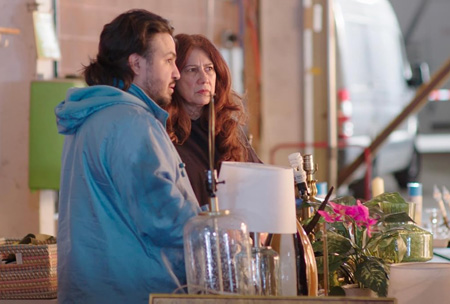
When it comes to the script, a solid forty-five minutes of the film takes place in the interrogation room – limited locations being ideal for an indie project – in a one-to-one conversation with the serial killer. I had to make sure the content of that conversation sparkled with clarity, conflict, and propulsion; you have to work the script until the decisions that were made due to limitations in budget stop looking like decisions made for that reason and instead look like the best creative choice possible.
And finally, this is perhaps the most amazing cast and crew I’ve ever had. There are a number of them I would call brilliant and hope will be my lifelong collaborators moving forward. They all exhibited an enthusiasm, passion, and commitment to this project that far exceeds the paychecks we were able to deliver to them.
But, this three-fold lightning in a bottle is a form of luck that happens only as a consequence of deliberate, measured strategy.
~~~~~
~~~~~
CUBlog: To step back a bit from the movie and premiere, what are your professional trades when you are not on a film set or in an editing suite? Please talk a bit about your life as an artist, writer, teacher, and director, and what you’ll be doing now and in the future as a friend and neighbor in Champaign-Urbana.
VMR: I’ve lived in Champaign for five years now, and I think this is an incredible community, one that is not just supportive of the arts but truly understands the necessity for it. So much of the country at the moment, to me, feels a little afraid to dream, and yet I never feel any trace of that here.
In my other life, I am the executive director of the Champaign-Urbana Symphony Orchestra, a job I started only this past June. In addition, I also teach acting, writing, and directing virtually, at my own studio [The Hive SJ] to many students in California. I hope I’ll get the chance to do a little more teaching here in central Illinois as well. I’m already in discussions with Forge Film Acting based out of Rantoul to run a few acting and writing classes.
CUBlog: What brought you to the Twin Cities? I believe you’ve mentioned elsewhere that your wife is now employed here. Do you have family members in the area?
VMR: Actually, when my job went remote during the pandemic, my wife and I realized we could live anywhere in the US with a cheaper cost of living than California. Since my wife had done her doctorate at the University of Illinois and we had really liked it here, we decided this would be the place. We bought a house, packed up our lives, an actually moved away from family. We wanted to be in a place where we could afford to be artists, to commit ourselves to our passions, and I’m thrilled to say we’ve been making the most of that. Of course we miss family, but making DARK SOUL RIVER has introduced me to a lot of new people, and I feel like we are in the process here in town of building our own found family, if you will.
CUBlog: The enthusiasm for how everything went with DARK SOUL RIVER is very palpable with you, and we’re grateful to hear that you have the intention to live in Champaign-Urbana as a resident and creative force for some time. Can you hint at what might be the next project or projects in the movie vein for you? Are there other endeavors that you are interested in exploring here in east central Illinois, such as your work in theater like with a revisionist take on The Jungle Book staged previously in the Bay Area?
VMR: I think the most exciting thing about being an artist to me is I never fully know what the next chapter will bring. When people ask me what type of stories I like to tell, I never have the answer they expect, because I grew up admiring Rob Reiner who did MISERY, A FEW GOOD MEN, WHEN HARRY MET SALLY, THE PRINCESS BRIDE, STAND BY ME, and THIS IS SPINAL TAP all within years of each other. Will my next film, when it comes time, be action, romcom, or sci-fi? Well, I have ideas for all three. Or maybe, in the interim, I’ll write a fantasy book, or get involved in theater, or work on a new media music project. I’m open to any artistic opportunities that the future might bring, and that’s the fuel that keeps me going.
CUBlog: How can folks follow your filmmaking and arts career or contact you for professional services or collaboration?
VMR: Feel free to follow me on Instagram. I’m in the process of building a website as well.
~~~~~
~~~~~
Interview conducted September 7-17, 2026, via e-mail.
It has been slightly edited and reformatted for reading ease.
CUBlog Interview © 2026 Jason Pankoke
DARK SOUL RIVER photos: Michael Paris Stone/
courtesy Vijay M. Rajan via IMDb.com
DARK SOUL RIVER design: Paul Johnstone/
courtesy Vijay M. Rajan
Read Jessica Hammie’s talk with Vijay R. Rajan at Smile Politely that covers additional aspects of the film, including how the nature of the serial killer character, Nathanael Ambrose, compares to Hannibal Lecter, the various influences and instruments reflected in Forrest Gray’s music score, and the concept of “genre film” as a valuable vehicle for storytelling and thematic heft.